
Company a Day #3: UMB Financial
The Relationship Bank

Disclaimer: this post discusses publicly available non-financial information about a publicly traded company. Nothing discussed here should be used as the basis to make an investment decision. Information is purely for educational purposes. The writing includes the use of AI and AI-Generated images based on the author’s research and notes.
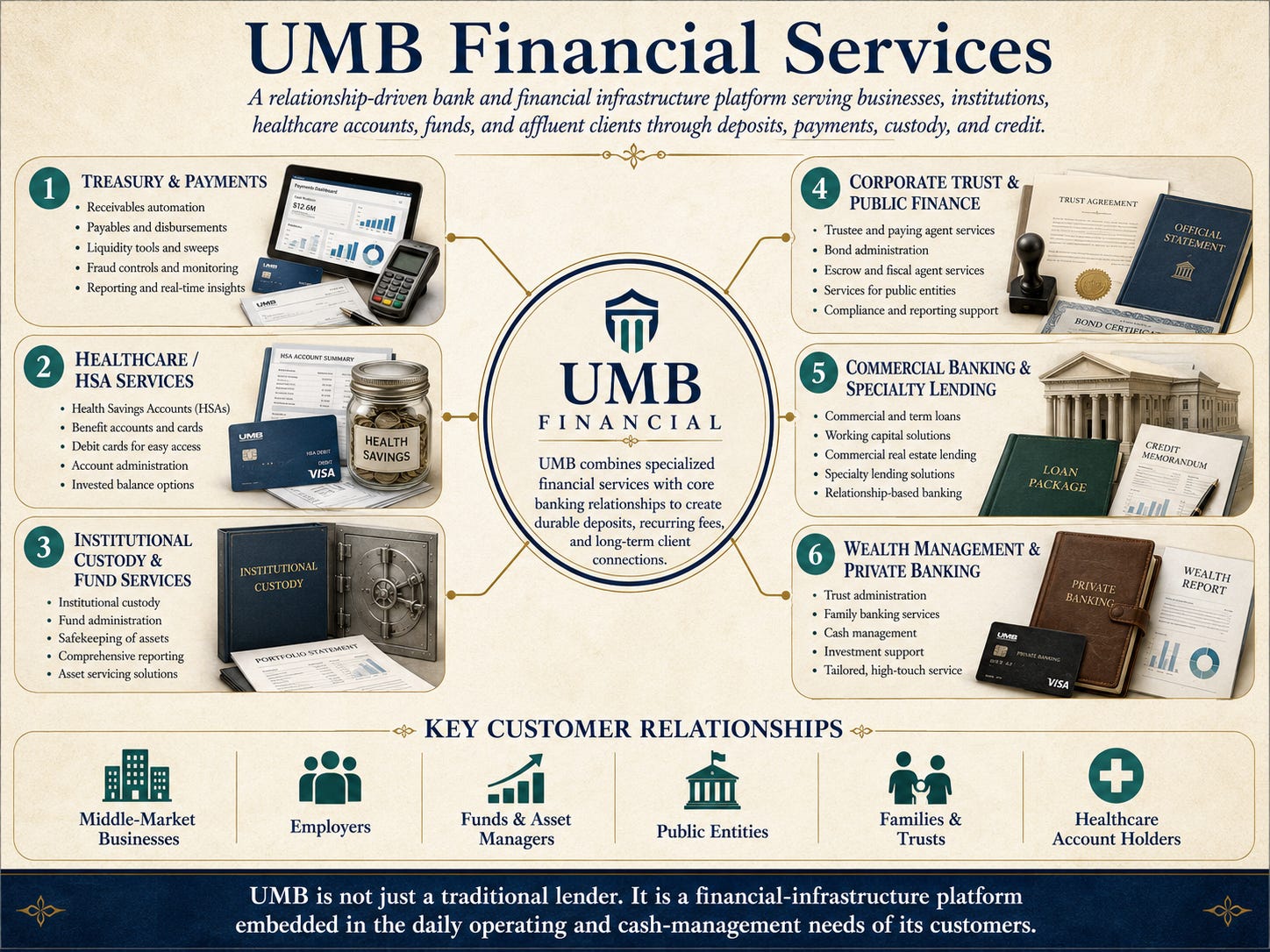
UMB Financial Corporation is commonly grouped with regional banks, but that label captures only part of the business. Headquartered in Kansas City, Missouri, UMB operates a commercial bank across the Midwest and Southwest, yet many of its most distinctive and valuable operations reach far beyond its branch footprint. The company has built national businesses in healthcare banking, treasury management, payments, corporate trust, fund services, custody and wealth management. Together, those activities make UMB resemble a financial-infrastructure company housed inside a conservative commercial bank.
As of the first quarter of 2026, UMB reported approximately $77 billion in assets, $58 billion in deposits and $45 billion in loans, along with more than $480 billion in assets under administration and custody. Those figures describe the scale of the franchise, but the balance sheet alone does not explain its economics. A meaningful portion of UMB’s value comes from fee income, operational deposits, payment flows, trust administration and long-duration customer relationships. The bank’s central proposition is to build specialized financial businesses that become embedded in customers’ daily operations, allow those businesses to gather stable and relatively low-cost deposits, and then use the resulting relationships to support conservative lending and wealth-management activity.
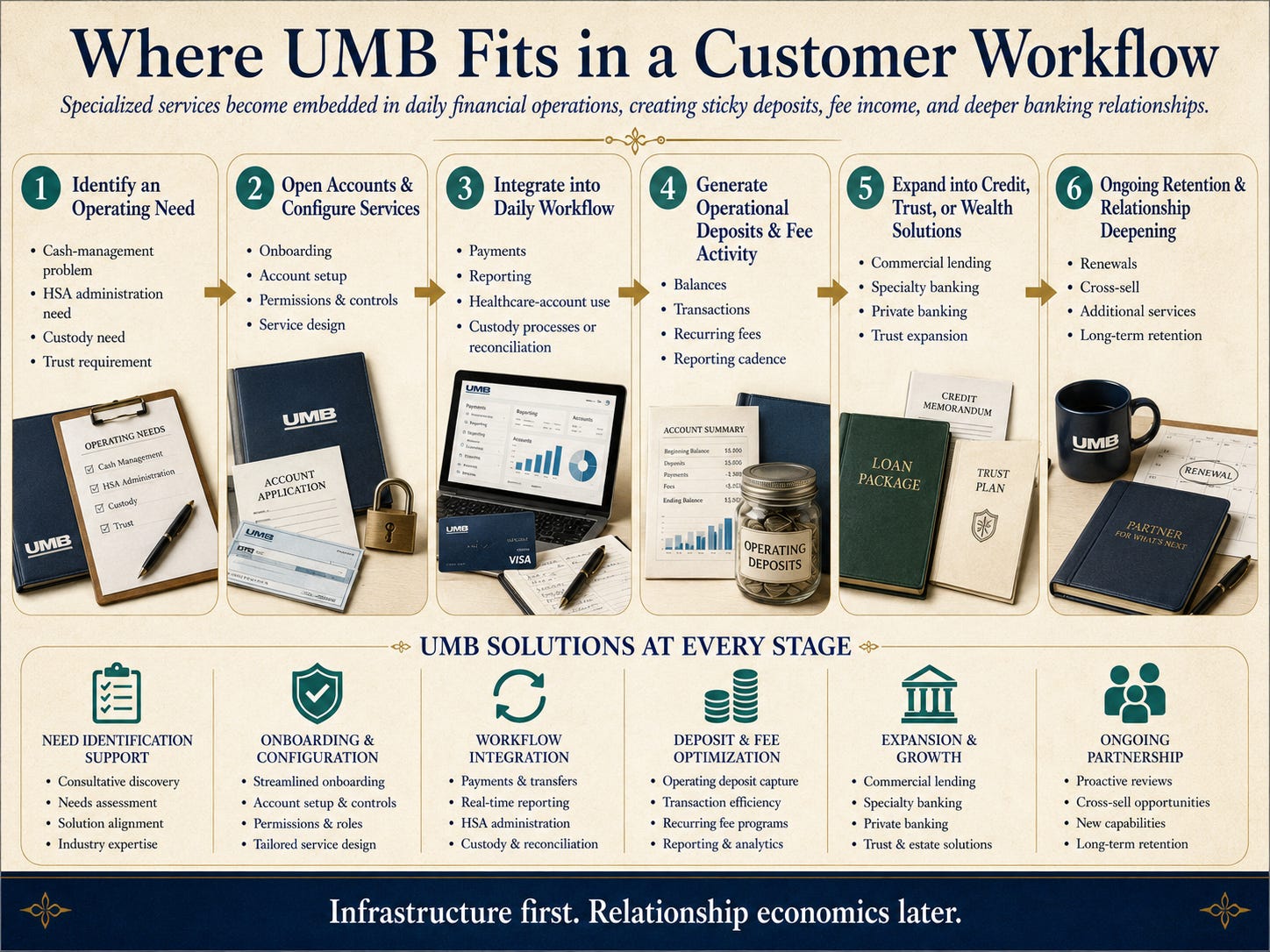
That sequence is important. Many banks begin a relationship by offering credit and hope to cross-sell deposits or fee services afterward. UMB often works in the opposite direction. A healthcare administrator may first need health savings account infrastructure. A mutual fund may first need custody and fund administration. A municipality may need cash management or bond-trust services. A corporation may need a treasury platform capable of moving money securely and reconciling thousands of transactions. Once UMB becomes responsible for those operational functions, deposits naturally arrive and additional services become possible. Lending is frequently a later stage of the relationship rather than the product that created it.
A Century of Gradual Specialization
UMB traces its origins to 1913 in Kansas City. For much of its history, it operated as a successful Midwestern commercial bank, but it did not try to become a national consumer institution or compete with the largest banks through branch density alone. Management instead expanded gradually into specialized financial niches where reputation, operational accuracy and long-standing relationships mattered more than mass-market scale.
Over time, the company developed expertise in municipal banking, institutional custody, corporate trust, asset servicing, healthcare accounts, treasury management and payment processing. Growth came through a mixture of organic relationship expansion, targeted acquisitions, new specialty businesses and selective geographic expansion. Although the mix of businesses evolved, the underlying culture remained relatively consistent: conservative underwriting, strong liquidity, stable deposits, recurring fee income and long-term customer relationships were generally valued more highly than rapid balance-sheet growth.
The result is a bank whose structure differs from that of many regional peers. A conventional regional bank may derive most of its identity from lending into local commercial real estate, small businesses and consumer markets. UMB participates in all of those areas, but its defining capabilities are the systems that administer money, hold assets, process payments and connect customers to the financial infrastructure they use every day.
Relationship Banking in Reverse
UMB’s model is easiest to understand through the way a relationship develops. Consider a healthcare benefits administrator that needs a custodian and operating platform for health savings accounts. UMB can provide the accounts, hold cash balances, support investment options and administer transactions. As the relationship deepens, the customer may also use UMB for treasury management, payments and commercial banking. The bank did not win the relationship by offering the lowest-priced loan. It won by solving a specialized operating problem.
The same logic applies to institutional clients. A mutual fund or investment manager may hire UMB for custody, fund administration, securities processing or cash management. Those activities bring assets, transactional volume and operating deposits into the bank. Additional services can follow because UMB is already integrated into the client’s workflow. In this model, the relationship begins with infrastructure rather than credit, creating switching costs that are often substantially higher than those associated with an ordinary deposit account.
Commercial Banking as Part of a Broader Relationship
UMB’s commercial bank serves middle-market companies, manufacturers, distributors, service businesses, agricultural enterprises, nonprofits and commercial real-estate owners. It offers commercial loans, working-capital lines, equipment finance, deposits, foreign exchange, letters of credit and treasury-management services. The products themselves are familiar, but UMB’s approach is designed around broader, multiproduct relationships.
Commercial real-estate lending includes office, industrial, multifamily, retail and mixed-use properties. Historically, UMB has maintained a relatively conservative posture in the category, emphasizing credit quality and relationship value rather than pursuing maximum loan growth. That discipline can make the bank appear less aggressive during strong credit cycles, but it has also helped limit credit losses when conditions weaken.
Commercial and industrial lending finances operating businesses rather than investment properties. UMB may lend against accounts receivable, inventory, equipment or cash flow to support working capital, expansion or acquisitions. These relationships are often strategically attractive because an operating company needs much more than credit. It must move payments, manage payroll, collect receivables, protect against fraud and maintain liquidity. A loan can therefore sit inside a larger system of deposits and fee-generating services.
Treasury Management and the Cost of Switching
Treasury management is one of UMB’s most important capabilities because it places the bank inside a customer’s financial operating system. The company provides automated clearinghouse origination, wire transfers, positive pay, remote deposit capture, fraud controls, liquidity management, cash forecasting and payment automation. These services are integrated with accounting software, internal approval processes, vendors and employee workflows.
Changing treasury providers is therefore much more complicated than transferring a checking balance. A business may need to alter software connections, reconfigure permissions, update vendor instructions, retrain employees and test the entire system before moving. The bank’s competitive advantage is not simply that it offers payment tools; most large banks do. The advantage comes from becoming reliable enough and deeply integrated enough that switching appears costly and risky.
That integration strengthens the franchise in two ways. Treasury services generate fees directly, and they also help retain the operating deposits that support the bank’s funding base. A customer may move excess cash in search of yield, but it is less likely to disrupt the accounts through which payroll, collections and vendor payments are processed.
Payments as an Infrastructure Business
UMB processes payment activity for corporations, healthcare organizations, government entities, asset managers and other institutional customers. The attraction of payments lies in their combination of recurring volume, operating leverage and customer stickiness. Much of the cost of building and maintaining a secure processing platform is fixed. Once the system is in place, additional transactions can often be handled at attractive incremental economics.
Reliability, however, is non-negotiable. Customers are not simply paying UMB to move money; they are paying for confidence that funds will arrive accurately, securely and on time. That makes payments both an attractive business and a significant source of operational risk. A service failure, fraud event or cybersecurity breach can damage a relationship much faster than a modest difference in pricing can improve it.
Healthcare Banking and the HSA Franchise
Healthcare banking is among UMB’s clearest areas of differentiation. The company administers health savings accounts, flexible spending accounts, health reimbursement arrangements, COBRA programs and other consumer-directed healthcare accounts. UMB has become one of the largest HSA custodians in the United States, giving it a position in a market that combines financial administration, deposit gathering and long-term asset accumulation.
An HSA is unusually attractive to a bank because it can generate several forms of value at once. Cash balances remain on deposit. Administrative services produce recurring fees. As accounts grow, customers may move a portion of their balances into investment products. The relationship can persist for decades because HSA funds may be retained for future medical expenses or retirement rather than spent immediately.
This makes healthcare banking resemble a specialized asset-gathering business as much as a deposit product. The account holder does not need to become a borrower for UMB to earn an attractive relationship. The bank can benefit from custody, administration, deposits, transactions and invested assets throughout the life of the account.
The model also creates a network of business relationships beyond the individual account holder. Employers, benefits administrators, insurers and technology providers all participate in the healthcare-account ecosystem. Serving them requires specialized systems and regulatory expertise that a generalist bank cannot reproduce merely by offering a checking account labeled as an HSA.
Institutional Banking Without Proportionate Credit Risk
UMB’s institutional bank serves mutual funds, investment managers, insurance companies, public entities, nonprofits, financial institutions and other organizations. Its services include custody, fund administration, corporate trust, securities processing, escrow and cash management. These businesses can generate recurring fees and deposits without requiring the bank to take the same level of credit risk associated with a traditional loan portfolio.
Corporate trust is a particularly specialized example. UMB may act as trustee for municipal securities, corporate debt, structured-finance transactions and asset-backed securities. In that role, the bank can hold collateral, process payments, maintain records, monitor contractual obligations and communicate with investors. It generally does not bear the underlying credit risk of the bond or security. Instead, it earns administrative fees for performing a legally defined and operationally sensitive role.
The economics depend heavily on reputation, legal expertise and accuracy. Once a trustee is appointed, replacing it can be cumbersome and is rarely done without a significant reason. That gives well-run relationships a long duration, although the business remains competitive and sophisticated clients can negotiate fees aggressively.
UMB also has deep municipal-banking relationships with cities, counties, school districts and public authorities. These entities need deposit accounts, treasury services, bond administration and cash management. Public-fund relationships can last for many years and produce large, stable deposits, though the balances often require collateralization and careful compliance with public-deposit rules.
In asset servicing, UMB safeguards securities, settles transactions, collects income, maintains records and produces reports for institutional clients. The assets remain owned by the customer; UMB earns fees based on the amount serviced, transaction activity and administrative complexity. As client assets grow, fee income can rise without requiring a proportional expansion of the bank’s own balance sheet. That characteristic makes asset servicing strategically valuable even when the percentage fee charged is modest.
Wealth Management and Multigenerational Relationships
UMB’s wealth-management business includes investment management, trust services, financial planning, estate administration and private banking. Trust relationships can extend across generations and create needs that touch several parts of the company, including custody, commercial banking, tax planning and philanthropic administration.
The strength of the business lies less in a single proprietary product than in the duration and breadth of the relationship. A family may use UMB to manage assets, administer an estate, serve as trustee, finance a business or organize charitable giving. Each service reinforces the others, and the bank’s institutional trust capabilities provide infrastructure that smaller wealth managers may not possess internally.
A Deposit Franchise Built Through Operations
UMB’s deposit base is unusually diversified because it comes from commercial customers, treasury-management clients, healthcare accounts, public funds, institutional relationships, wealth-management clients and traditional consumer banking. Many of those balances are operational rather than purely rate sensitive.
A corporate customer maintains cash at UMB because the bank is processing collections, payroll and payments. A public entity needs operating accounts tied to its treasury workflow. A trust relationship creates custody and escrow balances. An HSA platform naturally accumulates healthcare deposits. In each case, the deposit exists partly because the customer depends on an underlying service.
That distinction matters when interest rates rise. Customers who hold deposits solely for yield can move quickly to the highest-paying alternative. Customers whose deposits are tied to operational systems must weigh a small increase in interest against the cost and risk of changing providers. Operational balances can therefore exhibit a lower deposit beta, meaning their cost may rise less than market rates. A lower beta supports the bank’s net interest margin and gives UMB a funding advantage relative to institutions that rely more heavily on rate-sensitive deposits.
The advantage should not be overstated. Large institutional and commercial customers are sophisticated and will still demand competitive pricing, particularly on surplus balances. Yet the underlying services give UMB a reason for the relationship to persist even when deposit competition intensifies.
Fee Income Changes the Earnings Mix
Net interest income remains an important driver of UMB’s earnings, but the bank is less dependent on loan growth than a typical regional lender because it also earns trust, healthcare, treasury-management, asset-servicing and payment-processing fees. Those activities diversify the revenue base and can grow without a proportionate increase in risk-weighted assets.
Fee businesses require people, technology, compliance and operating infrastructure rather than large amounts of balance-sheet leverage. When customer volumes rise, the resulting operating leverage can support attractive returns on equity. Their quality, however, depends on retention, service reliability and continuing investment. Unlike credit income, which can look strong until losses emerge, infrastructure fees can erode if systems fall behind or customers conclude that a larger competitor offers better capabilities.
Technology as Both Advantage and Obligation
Nearly every differentiated UMB business is technology intensive. Treasury platforms must integrate with customer systems. Healthcare accounts require secure administration and investment functionality. Payment systems must operate continuously while detecting fraud. Trust and custody platforms must maintain precise records and satisfy complicated reporting requirements.
Technology can create customer stickiness, scale economies and barriers to entry. Once a platform serves a large customer base, additional volume can improve economics. But the investment cannot stop. A bank competing on infrastructure must continually modernize its systems, strengthen cybersecurity, improve user interfaces and adapt to changing regulatory requirements. The same technology that helps create a moat also creates a permanent capital-spending and execution obligation.
A Conservative Credit Culture
UMB has long emphasized return on risk, relationship quality and balance-sheet resilience rather than maximizing loan growth. Historically, that posture has contributed to lower charge-offs, less credit volatility and stronger capital preservation. It also creates a tradeoff: during aggressive lending booms, a conservative bank may report slower growth than competitors willing to relax standards or price loans more thinly.
The credit culture is strategically important because it supports the rest of the model. UMB’s specialty businesses bring deposits and relationships into the franchise; management does not need to force loan growth simply to justify the deposit base. The bank can be selective about where it deploys capital, ideally lending to customers it already knows through treasury, payments or institutional relationships.
Capital Allocation Around the Existing Franchise
UMB allocates capital among technology, organic lending, acquisitions, wealth management, dividends and share repurchases. Its acquisitions have generally strengthened existing specialty capabilities or expanded the company geographically rather than changing the bank’s identity altogether. This approach reflects a preference for extending the franchise into adjacent markets instead of pursuing transformational deals simply to increase scale.
The discipline matters because infrastructure businesses can be difficult to integrate. A transaction may look attractive based on revenue or deposits but destroy value if customer service declines, technology conversion fails or key employees leave. UMB’s long-term record depends on balancing the efficiency of centralized systems with the relationship continuity that attracted clients in the first place.
The Competitive Strategy: Become Operationally Indispensable
UMB’s competitive strategy is almost the reverse of conventional banking. Instead of trying to become the largest lender in each market, the company seeks to own specialized financial workflows. Healthcare administration, treasury management, corporate trust, custody and payments naturally produce fee income, deposits and long-duration customer relationships. Lending and wealth management can then grow around those connections.
Several advantages emerge from this structure. The deposit base is diversified across operating use cases. HSA accounts can remain in place for decades. Treasury systems create meaningful switching costs. Corporate-trust appointments and custody relationships can persist for long periods. Institutional assets can generate scalable fee income. A conservative credit culture protects the capital generated by those businesses. Finally, customers often use several services at once, giving UMB more opportunities to deepen a relationship than a bank offering only credit and deposits.
The moat is nevertheless based more on execution than on absolute pricing power. UMB competes with much larger custody, healthcare, payments and treasury providers. Institutional customers can negotiate fees, and technology spending must continue indefinitely. Regulatory complexity is substantial across banking, healthcare accounts, payments, trust and securities administration. The franchise is durable only if UMB remains operationally accurate, technologically current and responsive to customers.
Risks Beyond the Loan Book
UMB remains exposed to familiar banking risks, including commercial-credit deterioration, deposit competition, interest-rate changes and concentration among large customers. Yet some of its most important risks are operational rather than purely credit related. Technology failures, cybersecurity breaches, payment fraud, administrative errors or breakdowns in trust accounting could damage customer confidence and create regulatory or financial consequences.
Healthcare regulation can alter the economics or administration of consumer-directed accounts. Fee compression can reduce the profitability of institutional services. Larger competitors may use their scale to invest more heavily in technology or bundle services at lower prices. Public-fund and institutional deposits can be large, making individual relationships significant even when the overall deposit base is diversified.
These risks follow directly from the strategy. Becoming embedded in a customer’s operations produces stickiness, but it also raises the cost of failure. A lending error may affect one credit. A payment or trust-processing failure can affect many clients and undermine the reputation on which the entire relationship model depends.
The Central Strategic Question
The key question for UMB is whether it can continue expanding its specialized financial-infrastructure businesses without sacrificing the conservative operating culture that historically differentiated the bank. The model contains a powerful flywheel. Specialized services create operational relationships. Those relationships bring sticky deposits and payment activity. Treasury and institutional services deepen the connection. Lending and wealth-management opportunities emerge. The resulting fee income and capital can then fund further investment in the platform.
That flywheel works only when the underlying systems remain dependable. UMB does not win primarily because it prices a loan a few basis points below a competitor. It wins when a customer decides that the bank has become too useful, too integrated and too reliable to replace casually.
What UMB Does Differently
UMB uses financial infrastructure to gather deposits rather than relying predominantly on branches or promotional rates. It treats loans as products that deepen existing relationships instead of assuming that credit must create every relationship. It has built a meaningful earnings stream from trust, custody, healthcare administration, treasury management and payments. It concentrates on workflows that become embedded in customers’ operations, creating practical switching costs. At the same time, it has maintained a conservative approach to credit that favors durability over the fastest possible balance-sheet expansion.
None of those choices is unique in isolation. Large banks offer treasury management, custody and payments, while other institutions administer HSAs and corporate trusts. UMB’s distinction comes from the way these activities are assembled inside a regional banking franchise. The company has created a business broad enough to serve national institutional customers, yet disciplined enough to retain the relationship-oriented culture of a conservative commercial bank.
Conclusion
UMB Financial is best understood not simply as a bank with a collection of ancillary fee businesses, but as a financial-infrastructure company whose banking charter allows it to capture the deposits, lending opportunities and wealth relationships created by those services. Its most valuable assets are not only loans, branches or net interest margin. They are the long-duration operating relationships formed through healthcare administration, treasury management, payment processing, corporate trust, custody and wealth management.
Those businesses naturally gather deposits while producing recurring fees. Commercial banking grows around them rather than leading every customer relationship. The resulting franchise is more diversified than that of a conventional regional lender and less dependent on rapid loan growth, though it remains exposed to the continuing demands of technology, regulation and operational execution.
UMB’s long-term challenge is to maintain technological relevance while competing with institutions many times its size. Its opportunity is to remain more focused, more relationship-driven and more dependable within the niches it has chosen. If the company succeeds, its most important competitive advantage will remain the same: becoming deeply embedded in a customer’s financial operations before a competing bank ever has the chance to lend.