
Moving Forward
For the Sake of Compliance

I love writing and I love investing. It’s why I started Substack. To get exposure. I didn’t have a traditional story, but rather than letting that stop me, I decided I would use that to my advantage and actually tell it.
I’m pleased to say that I now have the opportunity to work for a company where I will be an investment professional. But there are downsides.
First and foremost is compliance. I have an odd tension with compliance. On one hand I am skeptical of certain calls to deregulate the securities industry as it is often secretly a way to increase systemic grift. However, not only does this tug on my own libertarian sensibilities in saying the government tends to be awful at doing almost anything, but the regulation tends to play on the principle of conservatism. When there is a grey area, erring on the side of trying no to get sued.
Most industries rely on caveat emptor “let the buyer beware” in other words, the expectation is that in lieu of negligence on the part of the seller, the buyer should do their due diligence before purchasing.
However, the securities industry as a tendency goes on caveat venditor “let the seller beware” in which the seller is responsible for ensuring a reasonable fit for the buyer.
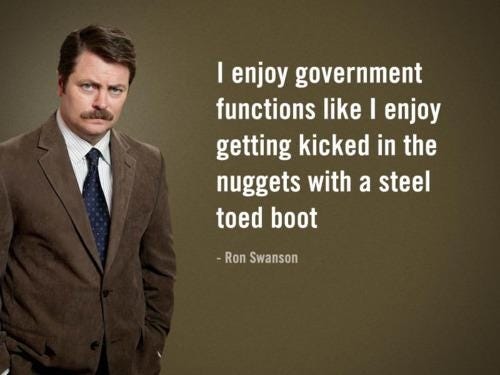
Now I won’t bore you with my opinions on the regulatory landscape, the above meme does that just fine. I just wanted to set the stage for future posts
Philosophy is fine: I will be clear to write pieces related entirely to investing philosophy or history. Or completely unrelated to investing.
Business summaries: or in my words, business storytelling. As investors there are actually two components of a given investment. The story, and the valuation. The story tells you what the business is and gives a basis for developing opinions on how they will develop into the future. Valuation tells you given current assumptions (that you develop from the story) what the fair value of the business is. This is where we run into some issues.
Valuation will be sparse: in order to not be pilloried by my employer and stay in line with compliance none of my writing can give the impression that it is designed to help decide whether or not to make an investment decision. So that is the bridge I can’t cross. So if I can’t do valuation work, what’s the point?
Homo Fictus
As Jonathan Gottschall says, man is a storytelling animal. We use stories to make sense of a fundamentally uncertain world. Investing is a storytellers profession. I hate when value investors say they don’t buy into stories or narratives. Of course you do. Once you leave the realm of brute facts you begin to tell a story.
This net-net stock has to go up?
Why?
Well, it’s a net-net.
I can tell the story of fraudulent earnings, awful management, cyclicality, cash burn, whatever. The better formulation is looking for things like margins of safety. This is what makes Buffett, Graham, Klarman, and many other investors so revered. They thought probabilistically. But there is an art and a science to investing. Base rates, forecasting techniques, and other statistical tools should be used to help improve outcomes. But ultimately they are a fire to test the story you want to tell.
The story of a business
Businesses themselves are part of a story, which is just a narrative that contains characters, plot, setting, conflict, and resolution. Characters consist of economic actors. Customers, suppliers, competitors, investors. We all exist within a given setting which includes unique macro backdrops, competitive landscapes, customer moods and attitudes, etc. the fundamental goal of a corporation is to earn profits for shareholders through creating some incremental value for customers. That can be alleviating pains and frustrations, or creating joy and assisting with aspirations. But in order for the business to do that they have to navigate various conflicts from regulation, technology, direct competition, customer taste, the macro environment, and more. Resolution gets to an end stage. We assume over time some fundamental rate of change, positive or negative, in the net present value of the business. But an investment thesis fundamentally has to tell the story of a business. It’s just that a stock pitch is tailored to get the reader to believe one thing or another about a business.
My goal going forward is to use Substack as a living notebook. I am fascinated by businesses. My hope is to get the reader interested in the businesses I write about. I want to give them the tools to dig deeper, but not so much that they will be able to make a decision based on any given article I write.
Hopefully this newsletter will continue to bring value to its members and I truly appreciate everyone who takes the time to read my articles.