
Company a Day #11: Esquire Financial
The Lawyer's Bank

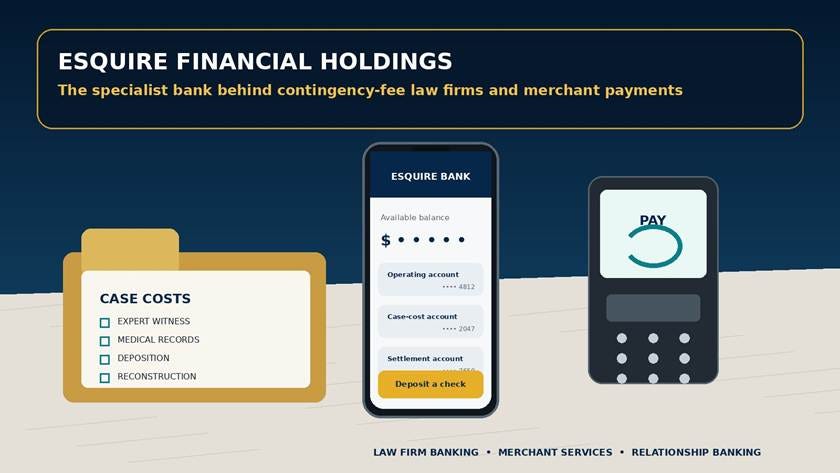
Disclaimer: this post discusses publicly available non-financial information about a publicly traded company. Nothing discussed here should be used as the basis to make an investment decision. Information is purely for educational purposes. The writing includes the use of AI and AI-Generated images based on the author’s research and notes.
Executive Summary
Esquire Financial Holdings is easiest to understand by starting with two moments that most consumers never associate with a bank. The first occurs when a contingency-fee law firm decides whether it can afford another expert witness, medical review, deposition or accident reconstruction before a case produces any cash. The second occurs when a customer taps a card at a merchant and the transaction must be authorized, cleared, settled and protected against fraud or chargebacks. Esquire operates deep inside both workflows.
The company is the holding company for Esquire Bank, National Association, a federally chartered commercial bank headquartered in Jericho, New York. It combines conventional banking powers—taking deposits, extending credit, moving money and administering accounts—with unusually specialized knowledge of plaintiff law firms and merchant acquiring. These verticals are national and largely branch-light; the bank also provides broader commercial and personal banking through relationship offices and digital channels.
The law-firm business is built around the mismatch between when a contingency-fee practice pays its expenses and when it is paid for its work. A plaintiff firm may carry a case for years while advancing expert, discovery and litigation expenses. Traditional banks frequently struggle to underwrite a firm whose most important asset is not a building or ordinary accounts receivable, but a diversified portfolio of unresolved legal matters. Esquire treats that case inventory as a financeable operating asset and uses purpose-built tracking to connect each advance to an individual case.
The merchant-services business occupies another specialized position. Esquire acts as an acquiring bank and sponsor behind independent sales organizations and merchant relationships. It participates in the regulated infrastructure that lets merchants accept cards and electronic payments, while managing the risks created when a merchant fails to deliver, a transaction is fraudulent or a cardholder disputes a charge.
These businesses look unrelated at first. Their common logic is information-intensive relationship banking. In each vertical, Esquire tries to understand the customer’s operating system more deeply than a generalist lender, control transaction-level data, build deposits around the workflow and price for risks that can appear opaque from the outside.
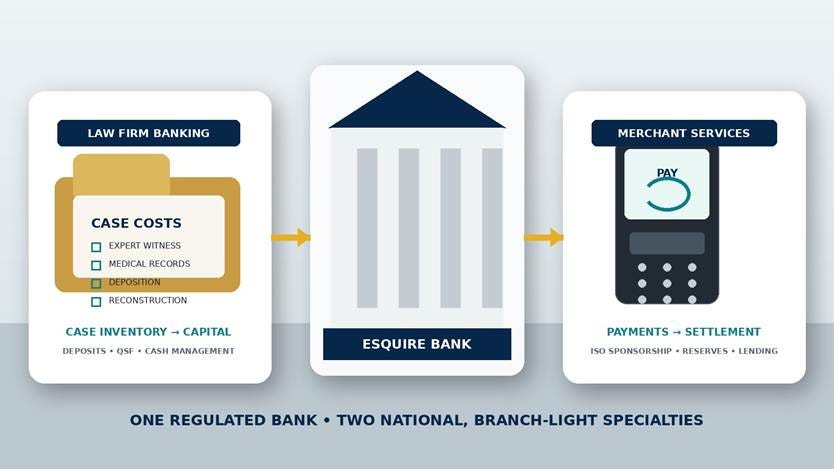
Esquire’s model combines one regulated bank with two national specialties: financing the operating cycle of contingency-fee law firms and serving as the acquiring-bank infrastructure behind merchant payments.
Business Overview
Esquire Financial Holdings owns Esquire Bank, N.A., which describes its model as “high-tech, high-touch” relationship banking. The bank’s principal national businesses are litigation-related banking and payment processing. It supplements them with commercial banking, real-estate lending, deposit products, treasury management and personal banking for selected relationships.
The legal-industry operation serves contingency-fee law firms, settlement administrators and plaintiffs. Its products include case-cost lines of credit, working-capital lines, growth capital, term loans, deposit and escrow accounts, qualified settlement fund services, common-benefit and settled-case financing, post-settlement plaintiff loans, Medicare set-aside accounts and accounts for minors or other protected beneficiaries. The products are designed around the sequence through which a case is sourced, financed, litigated, resolved and distributed.
The payment-processing operation serves independent sales organizations, payment facilitators, agents and merchants. Esquire can sponsor merchant programs, connect them with multiple processor platforms, support card-present, e-commerce, mobile, mail-order and telephone-order transactions, provide ACH and debit capabilities, maintain merchant and ISO reserves, and extend credit against processing portfolios or residual streams.
The bank’s product is therefore not a single loan or checking account. It is an integrated relationship in which credit, deposits, cash movement, underwriting data and operational controls reinforce one another. A law firm that borrows for case costs may also maintain operating, trust, escrow and settlement deposits. A payments partner may maintain reserves and settlement accounts while using Esquire for working capital or portfolio acquisition financing.
The model remains recognizably banking: deposits fund loans, borrowers pay interest, and payment relationships generate fees. What differentiates Esquire is the way those basic mechanisms are adapted to specialized workflows.
History: A Bank Founded Around an Industry Problem
Esquire Bank was established in 2006 and began operations in October of that year. Its origin was tied directly to the financing difficulties encountered by contingency-fee law firms. Ari Kornhaber, a former plaintiff trial lawyer and one of the company’s founders, brought first-hand knowledge of a practice model in which firms can be economically valuable while appearing unconventional to traditional credit departments.
The founding insight was that case inventory could be analyzed as a portfolio. A law firm’s matters differ in type, age, expected duration, case costs, defendants, insurance coverage and potential outcomes. No individual case is certain, but a sufficiently diversified practice with disciplined case selection and a demonstrated recovery history can be underwritten through data, monitoring and covenants. The bank was created to develop that specialty inside a regulated depository institution rather than a high-cost non-bank finance company.
In 2012, Esquire entered merchant payment processing. That move created a second national vertical with a different customer set but a similar need for specialized risk management. Instead of attempting to sell directly to every merchant, Esquire adopted an ISO-centered model in which independent organizations originate and manage merchant relationships while the bank provides sponsorship, settlement infrastructure, underwriting oversight and regulatory accountability.
The organization converted to a national-bank structure in 2015, supporting a nationwide operating model under a federal charter. Esquire Financial Holdings completed its public listing in 2017. During the following years, the bank invested in digital banking, customer relationship management, payment integrations and purpose-built case-cost systems while expanding its geographic reach beyond New York.
A Los Angeles flagship office added a physical relationship hub in a major legal and commercial market. As of July 2026, Esquire had also received stockholder and regulatory approvals for its proposed acquisition of Chicago-based Signature Bancorporation, with closing scheduled for August 1, 2026 subject to remaining conditions. Because that transaction had not yet closed at the report date, this report treats it as a pending strategic development rather than part of Esquire’s completed operating history.
The history is best read as a gradual expansion of the same institutional capability. Esquire began by understanding a form of collateral that other banks overlooked, then applied specialized underwriting and transaction controls to payment processing, and is now broadening its relationship-banking footprint without abandoning its vertical orientation.
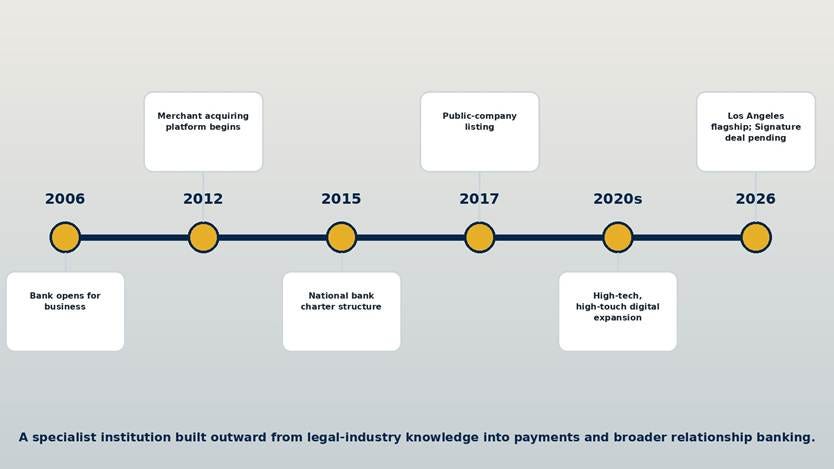
Esquire’s development has been a progression from a law-firm specialty bank to a national, technology-enabled platform spanning litigation finance, acquiring-bank services and broader commercial relationships.
The First Industry: Contingency-Fee Law Firms
A contingency-fee law firm is paid only if it produces a recovery for the client. The fee is typically a contractually agreed percentage of a settlement or judgment, subject to professional-conduct rules, client agreements and applicable law. Until the matter resolves, the firm may receive no fee for the lawyers’ time.
The timing problem extends beyond labor. Plaintiff firms frequently advance expenses necessary to develop the claim: filing fees, medical records, investigators, expert witnesses, depositions, travel, demonstrative exhibits, testing and reconstruction. A complex case can require repeated cash outlays long before a defendant, insurer or court produces a resolution.
This makes the firm economically different from a conventional professional-services practice. An hourly law firm invoices work as it is performed and creates accounts receivable. A contingency-fee firm accumulates an inventory of unresolved cases whose future value depends on legal merits, damages, liability, insurance coverage, litigation skill, duration and settlement behavior. The practice bears both working-capital risk and outcome risk.
Traditional bank underwriting often fits poorly. Personal guarantees and office assets do not capture the core value of the firm. A standard receivables formula does not work because there may be no fixed invoice until a case resolves. A blanket line of credit may also make it difficult to determine whether capital is being used for recoverable case expenses, overhead, partner distributions or expansion.
Non-bank litigation funders can provide capital, but their structures may be more expensive, more transaction-specific or more intrusive. Esquire’s strategic premise is that a bank with industry expertise can fund diversified firms at conventional bank economics while retaining enough monitoring to protect depositors and the institution.
The underwriting unit is therefore both the law firm and its portfolio. Esquire evaluates management, historical outcomes, case concentration, practice areas, funding needs, cash controls and the methods through which cases are tracked. Its proprietary system can establish an individual sub-account or record for each financed matter, letting the bank and firm reconcile advances when the case is resolved.
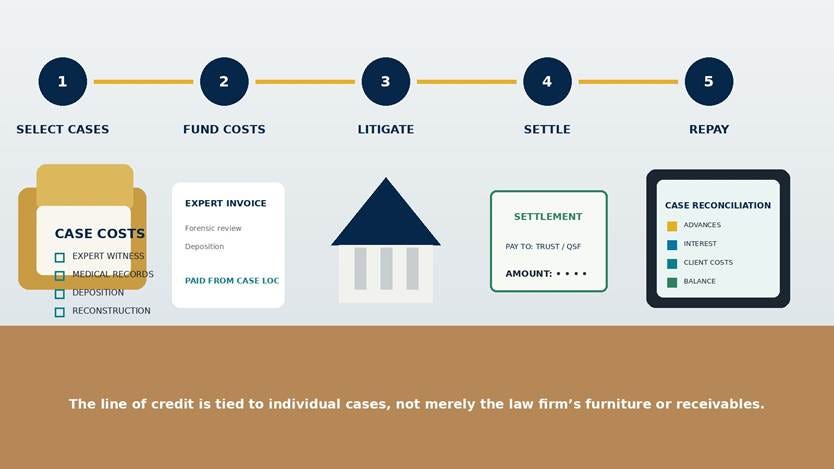
Case-cost finance follows the case lifecycle: select matters, advance identifiable litigation expenses, monitor the portfolio, receive settlement proceeds, reconcile the client’s costs and repay the line.
Why Case-Cost Financing Changes the Firm
The product can alter how a law firm allocates its own capital. Without outside financing, partners may fund expert and discovery costs from operating cash. That preserves debt-free ownership but ties up money that might otherwise support lawyers, intake staff, marketing, technology, office expansion or acquisitions.
By separating case expenses from ordinary overhead, a dedicated facility can improve managerial visibility. The firm can see which matters are consuming capital, reconcile recoverable costs, and match borrowing duration more closely to the case. Esquire can monitor the same information as lender.
The economic benefit is not simply that the firm can take more cases. Capital can let it pursue meritorious cases more thoroughly, avoid premature settlements driven by cash pressure and build the operating organization required to manage a larger docket. The risk is that easy credit can encourage weak case selection, excessive marketing or growth beyond managerial capacity. Esquire’s underwriting discipline therefore matters as much as the availability of funds.
The Second Industry: Merchant Acquiring and Payment Processing
A card payment appears instantaneous to the consumer, but it is a coordinated credit and data process involving several institutions. The cardholder presents credentials to a merchant. A gateway or processor routes the authorization request through a card network to the issuing bank. The issuer approves or declines the transaction. Later, clearing messages determine the amounts owed and settlement moves funds to the merchant through the acquiring side of the system.
The acquiring bank is the regulated institution that sponsors the merchant’s access to the card networks and bears important obligations when the transaction fails. It works with processors, independent sales organizations, payment facilitators and agents that identify merchants, install technology, provide support and manage the commercial relationship.
Esquire uses an ISO-driven model. The bank and an ISO can jointly enter merchant agreements; third-party processor platforms handle much of the transaction technology, while Esquire provides sponsorship, settlement and risk oversight. This is different from a fully direct processor that owns the sales force, gateway, processing stack and merchant service relationship. Esquire’s narrower role can reduce operating intensity, but it still leaves the bank exposed to merchant and partner risk.
The most important risk is that the merchant is paid before the economic obligation is final. A cardholder may dispute the charge. Fraud may be discovered. A merchant may close before delivering a future service. Card-network rules can require the acquiring bank to reimburse the issuer even if the bank can no longer recover funds from the merchant.
Risk is especially significant in businesses with delayed delivery, subscriptions, high refund rates, regulatory complexity or abrupt changes in sales volume. Esquire mitigates the exposure through merchant underwriting, transaction monitoring, contractual rights, merchant reserves, ISO reserves and the ability to retain residual payments otherwise owed to partners.
The bank’s flexibility across multiple processor platforms is strategically useful. It can serve different merchant types and technology needs without depending entirely on one processing stack. At the same time, multi-platform operations require strong reconciliation, compliance and data integration.
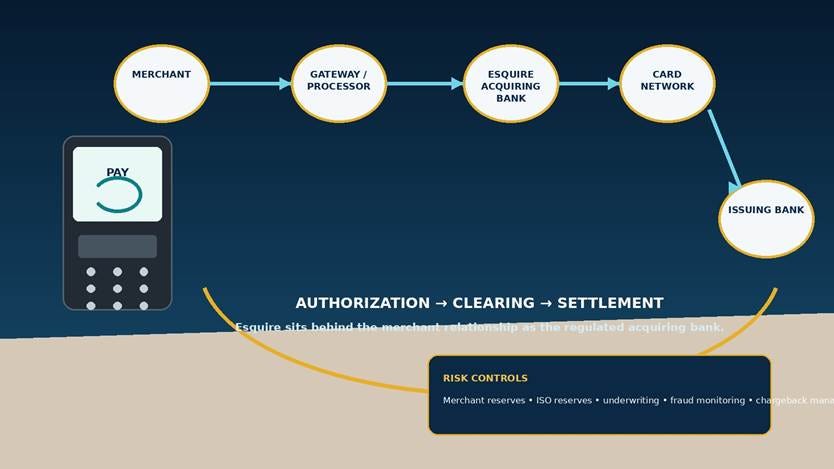
The consumer sees a tap or click; Esquire operates on the acquiring side of the network, linking merchants and ISOs to processors, card networks and issuing banks while controlling settlement and chargeback risk.
Products and Services
Law-Firm Credit
The flagship product is the case-cost line of credit. Qualifying contingency-fee firms can borrow against the economics of their case inventory and use the facility for identifiable litigation expenses. Each matter can be tracked separately, making it possible to associate advances, interest and repayment with the case that created them.
Working-capital lines serve a different need. They support operating expenses such as payroll, marketing, technology, expansion and general liquidity. Growth-capital and term-loan structures can finance acquisitions, partner transitions, office openings, technology investments or other strategic projects. The distinction matters because case expenses may ultimately be reimbursed from the client’s recovery, while overhead is borne by the firm.
Esquire also offers facilities tied to settled cases, class actions and common-benefit fees. Once a recovery or fee has been established but payment is delayed by administration, appeals, liens or court procedures, the underwriting resembles bridge finance against a more defined cash flow rather than a still-contested case.
Deposits, Trust and Settlement Administration
Law firms need operating accounts, client trust accounts, escrow services, remote deposit, wires, positive pay and fraud controls. Esquire can integrate these products with the lending relationship, giving the bank visibility into collections and the firm a single operating platform.
Qualified settlement funds are temporary legal and tax structures used to receive and administer settlement proceeds before final distribution. Esquire provides accounts, cash management and financing around these funds, as well as products for class-action settlements and common-benefit arrangements.
Plaintiff-facing products include post-settlement early-access loans, Medicare set-aside checking accounts and accounts for minors or other protected beneficiaries. These products extend the bank’s role from the law firm into the distribution phase of the claim.
Merchant Acquiring and Partner Services
Esquire supports card-present terminals, e-commerce, mobile, mail-order and telephone-order payments, debit cards and ACH. It can sponsor independent sales organizations under traditional ISO or BIN-sponsorship arrangements, support agent relationships and provide access to several processor, gateway and point-of-sale configurations.
For qualifying relationships, settlement proceeds can be made available on an accelerated basis. The bank also maintains reserve accounts and controls designed to absorb chargebacks or merchant failures.
Merchant-services financing includes working-capital loans, merchant term loans, portfolio-acquisition facilities and financing secured by agent residual streams. The collateral is the economics of the processing relationship: recurring payments earned from a merchant portfolio, subject to attrition, chargebacks, network rules and partner contracts.
Digital and Treasury Services
Online and mobile banking provide account balances, transaction history, check images, mobile deposit, transfers, wires, bill payment, secure messaging and positive-pay review. Remote deposit capture lets businesses scan checks from their offices. Treasury controls help firms and merchants manage large volumes of incoming and outgoing funds without relying on a local branch.
These features may appear ordinary, but in Esquire’s model they connect to specialized workflows. A law firm can move settlement proceeds, reconcile case costs and manage escrow. A merchant can receive settlement, maintain reserves and service a credit facility. The digital interface is the connective tissue between the specialty product and daily operations.
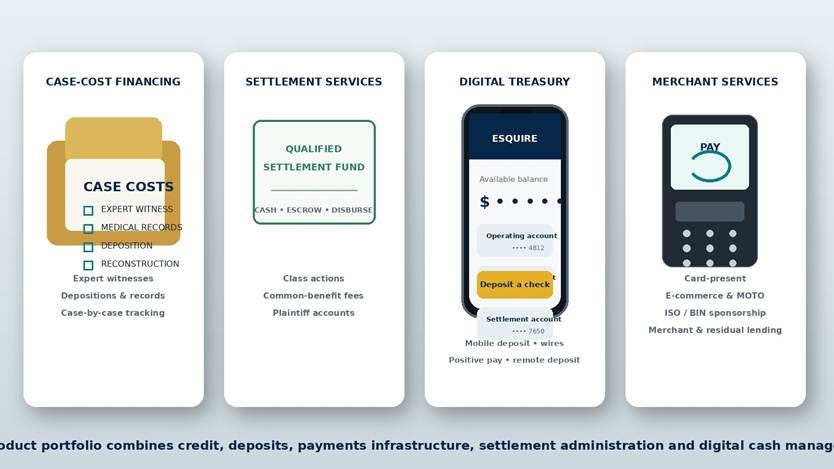
Customers encounter Esquire through a practical product suite: case-cost facilities, settlement and escrow accounts, mobile treasury management, acquiring-bank sponsorship and merchant financing.
How Customers Interact with Esquire
For a law firm, the relationship often begins with a financing need that exposes a broader operating problem. The firm may be paying substantial case costs from partner capital, growing faster than recoveries arrive, or pursuing litigation whose duration is difficult to match with a conventional loan. Esquire’s bankers review the firm, its case inventory, historical recoveries, management systems and funding plan.
Once a facility is established, the firm identifies eligible cases and records advances against them. The bank’s tracking technology creates a more granular ledger than a general-purpose revolving line. As matters settle, the firm reconciles financed expenses, invoices the client’s recoverable costs where permitted, deposits proceeds and repays the associated balance. Operating, trust and settlement accounts can sit alongside the credit facility.
The day-to-day product is therefore a workflow rather than a closing. Lawyers and finance staff use the line to pay experts and other case expenses, treasury tools to move money, remote deposit to collect checks and account controls to reduce fraud. Esquire’s relationship managers and credit staff continue to monitor the portfolio.
For a payments partner, the relationship begins with sponsorship and risk approval. The ISO or payment company brings merchant relationships and servicing capabilities. Esquire evaluates the partner, merchant categories, underwriting policies, processor configuration, expected volumes, fraud controls and reserve arrangements.
After launch, authorization and settlement data flow through third-party processors and the bank. Esquire receives fees, funds merchant settlement, maintains reserves, monitors anomalies and handles disputes according to network rules and contractual allocations. The partner services merchants; the bank remains accountable for the acquiring relationship.
The end merchant may never think about Esquire. It experiences the terminal, gateway, statement, settlement speed and support provided through the ISO. Esquire’s brand is more visible to law firms because the bank sells directly into that vertical, but in payment processing much of the company’s value is deliberately embedded behind another provider’s customer relationship.
The “high-tech, high-touch” proposition is not technology replacing bankers. It is software making a specialized relationship observable and manageable enough for senior bankers to make faster, better-informed decisions.
The Economics of Esquire’s Business
The economics begin with the basic banking spread. Esquire gathers deposits, pays depositors according to account terms and deploys part of that funding into loans. The difference between the yield on earning assets and the cost of funding must cover credit losses, operating expenses, regulation, capital requirements and a return for shareholders. What makes Esquire distinctive is the composition of both the deposits and the loans.
Law-firm relationships can produce several pools of deposits: operating cash, client trust balances, escrow, settlement proceeds and qualified settlement funds. Merchant processing creates settlement accounts and reserves maintained to protect the acquiring bank. These balances can be operationally sticky because they are embedded in a customer workflow rather than gathered solely by offering the highest rate.
On the asset side, specialty loans may command pricing that reflects complexity, limited competition and the bank’s ability to understand unconventional collateral. A case-cost facility is not simply a small-business loan with a different label. The bank has invested in legal-industry staff, portfolio data and monitoring systems that make the risk financeable.
Payment processing produces fee income rather than primarily interest income. Esquire receives a small share of the economics generated as transaction volume passes through the acquiring relationship. The percentage can be measured in basis points and is shared among the merchant, ISO, processor, card network, issuing bank and other participants. Because Esquire operates largely through ISOs and external processors, it captures less of the gross merchant discount than a vertically integrated direct processor, but it also avoids much of the sales, terminal and processing-stack expense.
Additional fees can arise from treasury management, account services, settlement administration and other banking activities. The important economic distinction is that some revenue compensates Esquire for putting capital at risk, while other revenue compensates it for moving money, maintaining infrastructure or assuming network obligations.
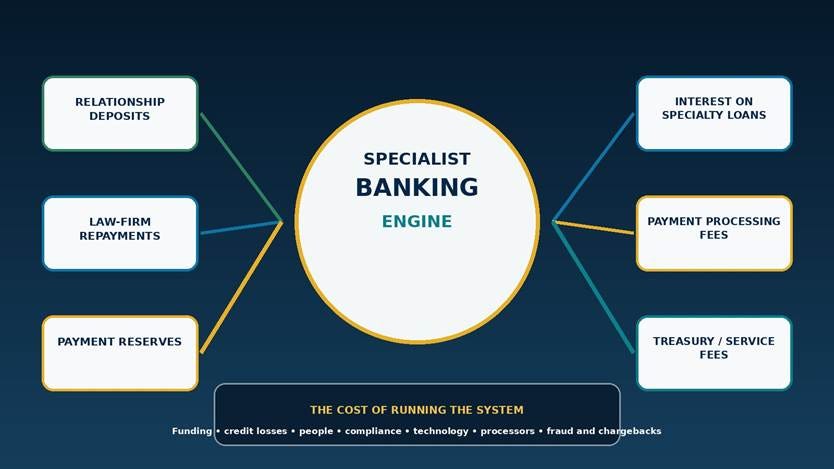
Esquire converts relationship deposits and reserve balances into specialty credit while earning payment and service fees; the model is constrained by funding costs, credit risk, compliance, technology and transaction losses.
The Cost of Running the System
The largest first-principles cost is funding. Deposits are liabilities to customers, and the bank must pay enough to retain appropriate balances while preserving the value of its relationship-based franchise. Interest-rate competition can raise the cost even when the underlying customers remain loyal.
Credit losses are the central risk cost. A law firm can suffer adverse case outcomes, concentration, fraud, weak management or prolonged duration. A merchant can generate chargebacks, cease operations or misrepresent its business. Esquire must maintain underwriting, monitoring and loss reserves appropriate to those exposures.
People are another major cost. Specialized bankers, legal-industry credit officers, payment-risk professionals, compliance personnel, technologists, operations staff and relationship managers are not interchangeable with generic branch labor. The company’s edge depends on retaining individuals who understand the verticals.
Technology and data-processing expenses include core banking, case tracking, online and mobile banking, cybersecurity, transaction reconciliation and connectivity to processors. Esquire also depends on outside payment processors and networks, creating contractual and vendor costs.
Regulation is structurally important. As a national bank and acquiring institution, Esquire must comply with capital, liquidity, consumer, anti-money-laundering, Bank Secrecy Act, privacy, fair-lending and card-network requirements. Specialized or higher-risk merchants require intensified due diligence. Legal settlement accounts impose fiduciary and operational responsibilities.
The physical cost base is smaller than that of a traditional retail network, but it is not zero. Relationship offices, headquarters, operations centers and the Los Angeles flagship support client acquisition and service. Esquire’s branch-light strategy is valuable because it directs more of the operating model toward specialist personnel and technology rather than widespread consumer distribution.
Economic Flywheels
The law-firm flywheel begins when credit solves the customer’s case-cost problem. The relationship can then attract deposits, trust balances, settlement funds and treasury activity. Those deposits lower the effective cost of funding future credit, while account data improves visibility into the borrower. Stronger service can produce referrals within the trial-lawyer community.
The payments flywheel begins with ISO sponsorship. More merchant relationships produce more transaction data, fee activity and reserve balances. Strong risk management protects the bank and makes it a more credible sponsor. Credit products secured by portfolios or residuals deepen the relationship with high-quality partners.
Both flywheels depend on selection. Growth that weakens underwriting can reverse the model quickly. The bank must avoid confusing transaction volume with durable economic value or case counts with collateral quality.
Competitive Strategy
Vertical Specialization
Esquire’s primary competitive strategy is to choose markets where generalist banks lack a usable underwriting framework. Contingency-fee law firms do not fit ordinary receivables lending, and merchant acquiring requires risk systems far removed from local commercial banking. By focusing, Esquire can build staff, data, contracts and products around the actual operating model of the customer.
This specialization creates a language advantage. A plaintiff lawyer does not need to explain why an expert cost is economically different from overhead. An ISO does not need to teach the bank the meaning of residuals, reserve waterfalls or delayed-delivery exposure. Familiarity can accelerate decisions and improve product design.
A Bank Charter Against Non-Bank Competitors
In law-firm finance, Esquire competes not only with banks but with litigation finance companies and other specialty lenders. A bank can fund itself through deposits and offer cash management, cards, wires, escrow and trust products alongside the loan. That integrated capability can support a lower-cost and more durable relationship than a standalone fund whose capital must earn a private-market return.
The charter also matters in payment processing. Card networks require acquiring-bank sponsorship, making the regulated bank a necessary node in the system. Esquire can combine that position with credit and deposit products for ISOs, agents and merchants.
Technology That Makes Unusual Collateral Legible
Technology is most strategically important when it converts an opaque risk into structured information. Esquire’s case-cost tracking lets it observe individual matters, advances and reconciliations. Payment systems provide transaction, reserve and chargeback data. Digital treasury tools place cash movement inside the same relationship.
The bank is not trying to win through a consumer application with the most features. Its technology advantage is workflow specificity: the system should help the customer operate and help the bank underwrite.
National Reach Without a National Branch Network
Esquire sources law-firm and payment relationships across the United States while operating a limited physical network. Industry conferences, referrals, digital content, specialist salespeople and partner channels replace mass-market branches. This broadens the addressable market without requiring the infrastructure of a national retail bank.
The strategy still benefits from selective physical locations. Jericho anchors the institution, Boca Raton supports administration and Los Angeles creates a relationship center in a major legal market. The proposed Signature transaction would add Chicago and a broader commercial-banking platform if completed.
Risk Architecture as a Commercial Product
In both verticals, customers are effectively buying Esquire’s willingness to understand and control risk. Law firms receive capital because the bank can monitor case inventory. ISOs receive sponsorship because the bank can supervise merchants, reserves and processor relationships. The control system is not merely a back-office requirement; it is what makes the product available.
Esquire’s ability to work with multiple payment processors can reduce platform dependence and accommodate a wider range of merchants. Its reserve structure and contractual access to ISO residuals provide layers of protection when losses emerge.
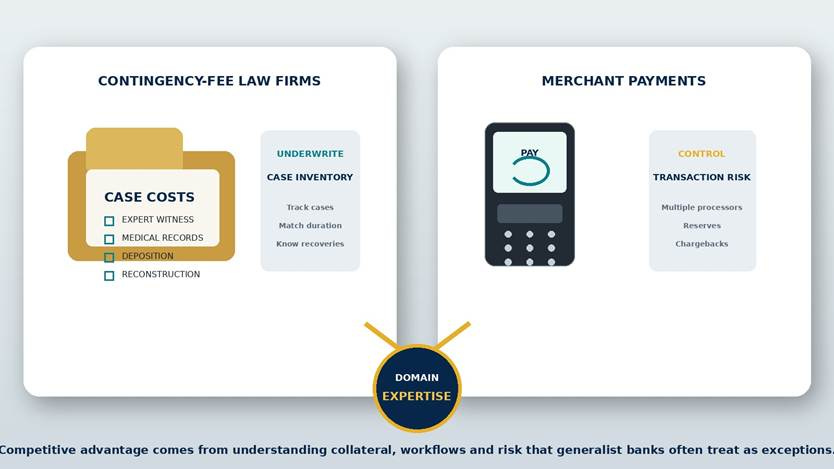
Esquire’s moat is not a proprietary consumer brand. It is domain expertise embedded in underwriting, transaction controls, contracts, deposits and relationship service.
Competitive Limits and Business Risks
Specialization creates concentration. A change in the plaintiff-law ecosystem, legal ethics, litigation-funding regulation, tort law or settlement behavior could affect a meaningful portion of Esquire’s franchise. The same expertise that distinguishes the bank makes rapid diversification difficult.
Case inventory is probabilistic collateral. Historical recoveries and diversification can support underwriting, but they cannot eliminate adverse verdicts, appellate reversals, uninsured defendants, fraud or prolonged duration. A law firm may also fail because of weak intake, marketing economics, partner disputes or operational growth beyond its capacity.
Merchant acquiring can generate sudden losses. Chargebacks may arrive after settlement funds have been released. High-risk merchants can change their behavior, and ISOs can fail to supervise agents. Card networks can impose fines or terminate access. Esquire depends on its own controls and those of processors and partners.
Third-party processor dependence is a strategic trade-off. It lets Esquire operate without building a full payment stack, but service failures, contract disputes, cyber incidents or platform changes at Global Payments, Fiserv, REPAY or other vendors can affect the bank and its merchants.
Deposits connected to settlement, trust or merchant reserve activity may be operationally valuable, but individual balances can be large and move when a matter resolves, a merchant portfolio transfers or market rates change. Liquidity management must account for the event-driven nature of some funds.
Regulation can become more demanding as the bank grows or enters new markets. Payments, higher-risk merchants, anti-money-laundering controls and consumer-facing plaintiff products require particularly careful oversight.
The pending Signature acquisition, if completed, would broaden geography, employees, systems and commercial relationships. It would also introduce integration risk and a potential tension between Esquire’s tightly focused culture and a wider middle-market banking platform.
Finally, the model depends heavily on institutional knowledge. A relatively small group of senior bankers, credit officers and payment-risk professionals may hold relationships and judgment that are difficult to codify fully. Succession, recruitment and cultural consistency are therefore strategic issues rather than ordinary human-resources concerns.
Conclusion
Esquire Financial Holdings is a bank built around activities that occur between familiar consumer moments. It finances the years of expense between a plaintiff’s claim and a legal recovery. It sits behind the seconds between a card tap and a merchant’s settlement. In both cases, the visible transaction is supported by a less visible system of underwriting, data, accounts, contracts and controls.
The law-firm business turns case inventory into bankable collateral. The merchant-services business turns an ISO’s customer network into a regulated acquiring relationship. Deposits, treasury services and specialty credit deepen both ecosystems.
The company’s products are not exotic versions of banking so much as conventional banking primitives assembled around unconventional workflows. Esquire takes deposits, lends money, moves funds and earns fees. Its advantage is knowing what to look at, how to monitor it and how to make those primitives useful to customers who are often poorly served by standardized bank products.
The central strategic question is whether Esquire can retain that underwriting intimacy as it grows. The franchise is strongest when technology extends specialized human judgment rather than replacing it, and when new geographies or products reinforce the vertical model rather than dilute it.
If Esquire succeeds, it remains a category-defining specialist: a national bank whose small physical footprint masks a deep position inside the operating systems of trial law and merchant payments.
The simplest description of Esquire is also the most revealing: it is a bank that makes difficult-to-understand cash flows bankable.
Selected Sources and Scope
This report is current through July 27, 2026. It intentionally excludes company financial statements, revenue, earnings, margins, balance-sheet figures, valuation and investment recommendations. The proposed acquisition of Signature Bancorporation is described as pending because the announced closing date had not yet occurred at the report date.
Esquire Financial Holdings 2025 Form 10-K: https://www.sec.gov/Archives/edgar/data/1531031/000110465926027706/esq-20251231x10k.htm
Esquire Bank — company and product overview:
https://esquirebank.com/
Law Firm Banking: https://esquirebank.com/law-firm-banking/
Case Cost Financing Solutions: https://esquirebank.com/law-firm-banking/case-cost-financing-solutions/
Business Loans and Lines of Credit: https://esquirebank.com/business-banking-solutions/business-loans-and-lines-of-credit/
Settlement Services and Products: https://esquirebank.com/settlement-services-products/
Plaintiff Products: https://esquirebank.com/law-firm-banking/plaintiff-products/
Merchant Services: https://esquirebank.com/merchant-services/
Merchant Processing: https://esquirebank.com/merchant-services/merchant-processing/
Independent Sales Organization Services: https://esquirebank.com/merchant-services/independent-sales-organization/
Merchant Services Financing: https://esquirebank.com/merchant-services-financing/
Cash Management Solutions: https://esquirebank.com/business-banking-solutions/cash-management-solutions/
Esquire Financial Holdings 2017 Form 10-K — history: https://www.sec.gov/Archives/edgar/data/0001531031/000114420418017879/tv488146-10k.htm
Senior Leadership Team: https://esquirebank.com/our-company/about-esquire-bank/senior-leadership-team/
American Bar Association Model Rule 1.5 — Fees: https://www.americanbar.org/groups/professional_responsibility/publications/model_rules_of_professional_conduct/rule_1_5_fees/
Visa payment acceptance and acquiring overview: https://corporate.visa.com/en/solutions/acceptance/payments.html
Second-quarter 2026 announcement and scheduled Signature closing: https://investorrelations.esquirebank.com/news/news-details/2026/Esquire-Financial-Holdings-Inc--Reports-Second-Quarter-2026-Results/default.aspx