
Bizarro World
Market Narratives, Opportunistic Value Investing, and Tacit Knowledge.

Bizarro World was the home world of Bizarro, the Anti-Superman. This world is ruled by the Bizaro World Code: “Us do opposite of all Earthly things! Us hate beauty! Us love ugliness! Is big crime to make anything perfect on Bizarro World!”
In one particularly humorous panel, Bizarro World Bonds are advertised “Guaranteed to lose money for you!”

I think about this as market narratives change around industries and sectors over time. In 2022 and 2023 Micron was an absolute dog of a stock, bouncing around between 4-7X EV/EBITDA and having negative EBIT in 2023. Now in 2026 it trades at 25X EV/EBITDA and 13X sales when it has historically bounced around in the 2-4X lane.
Comfort Systems USA. An HVAC contractor is now selling at over 6X price to sales despite bouncing around 0.75-1.5X range. That is to say nothing of companies like CAT, CMI, PWR, or the other Heavy Asset Low Obsolescence stocks which have now captured Wall Street’s imagination.
Approximately 5 years ago Adobe was at 60X EV/EBIT and 20X EV/Sales. Today those numbers are closer to 11X and 4X respectively. Take a look at DuoLingo, ServiceTitan, Toast, or Costar Group among several others. I am not saying any one of these companies is actually cheap or actually expensive. But the idea that some of the best performers today have been companies that were considered dead money just a few years ago reminds me why value is not fixed to any one business. But why exactly has there been such a dramatic narrative shift? Well, I will build off of some previous work linked below, but the answer is really the capital cycle.
Ill place a somewhat arbitrary cyclical starting point in 2011 when Mark Andreessen wrote Why Software Is Eating the World. I highly recommend it, especially for my tech-skeptical friends.
The core thesis was this. The cost of data had dropped so low that the incremental cost of adding new users for a given technology business was approaching 0. That had the knock-on effect of creating winner-take-most markets. These companies could create network effects which became stronger with each user. https://a16z.com/why-software-is-eating-the-world/
Thus the use of blitz-scaling, or burning money now to create a strong network and become dominant so as to charge later, became haute strategy. Google dominates search, Uber in rideshare, Amazon in e-commerce, the rise of Facebook. Realistically the only way to compete with these networks was to specialize. In normal competition you can compete by offering the same product at a lower price. But when the price is already close to zero your only other option is to differentiate. This is how LinkedIn or Etsy are able to survive. The value investor model of competition has historically been that of perfect-competition. Software’s economics simply baffled our brains.
Software had a real boom after the TCJA and the ability to remit several hundreds of billions back to the US. But it also set the stage for future disruption.
Artificial intelligence has been around in primitive forms for decades. Neural networks, Markov chains, and even natural language processing are not new concepts. In 2012 advances in hardware, software, and mathematics allowed for deep-learning, which is the process we think of today when we hear “training” AI. But it wasn’t until roughly 2017 when we were able to create large-language models that could actually take written or spoken language and create outputs. In 2020 ChatGPT was released and became the fastest technology ever to reach 1-million users. The promise of artificial intelligence to me is at least partially the same as the pitch by cloud or software providers when the technology was new. “Broad scale productivity improvement.” but hold on, that is the promise of software. As AI gets better the existing solutions will have a growing intensity of competition. That explains the death of software argument. I think the argument itself is a good one. If you take the era of 0 interest rates Pre-AI it seems that there are several companies which are not embedded in everyday operations, which do not integrate real AI into their service offerings, the low-code DIY space in SaaS is probably dead. Who needs low-code when you literally have “Tell me what to do and I will.” Finally, anything that represents a system-of-record type system is probably going to be disrupted. Finally, the large LLMs will disrupt “hobbyists” but not professionals. This is because of the tacit knowledge problem. As you professionalize in any craft you attain pattern recognition, you also build deep skill which requires incrementally better outputs. For an artist they often hate AI art because here is always something that looks “off” like you can tell it was A.I. generated but exactly what that means can be hard to describe. Or think of it like golf. Why are some clubs $200 and some are $1,500. Again there is a tacit knowledge problem.
I only hit the ball every ⅔ swings. Of my hits about ¾ are going to be a slice. But for some of my friends with a sub 10 handicap a different club will affect plenty of things that actually matter to the game: the dispersion of balls, predictability of launch height, ball spin, distance control etc. Not to mention being less physically taxing, which adds up overtime. A.I. Can be a cheap golf club. It does everything fine. But the fine tuning requires going upmarket. The question now is if AI can improve in such a way that the pure play LLMs can take market share from the companies that rely on the tacit knowledge of the users. On that I have no particular opinion except to say that I will believe it when I see it and until then I will continue to hunt for bargains as they appear. What will be important are avoiding the people selling the shovels, try to find the ones selling heavy equipment
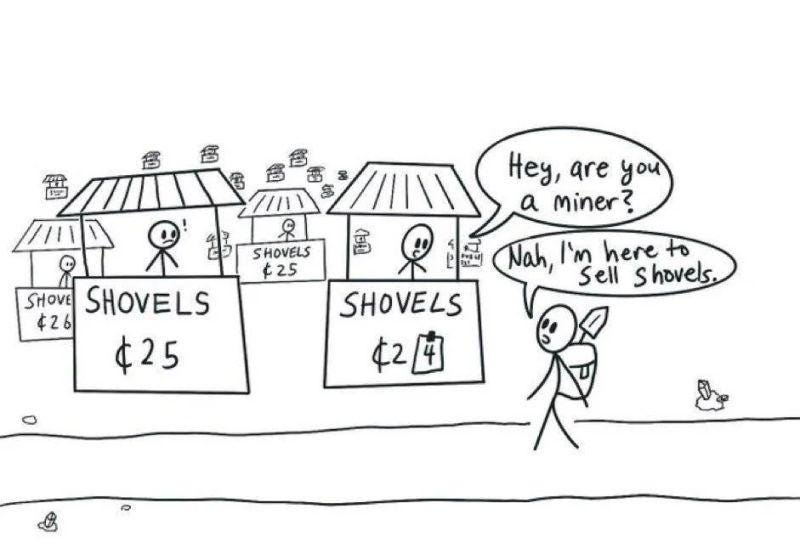
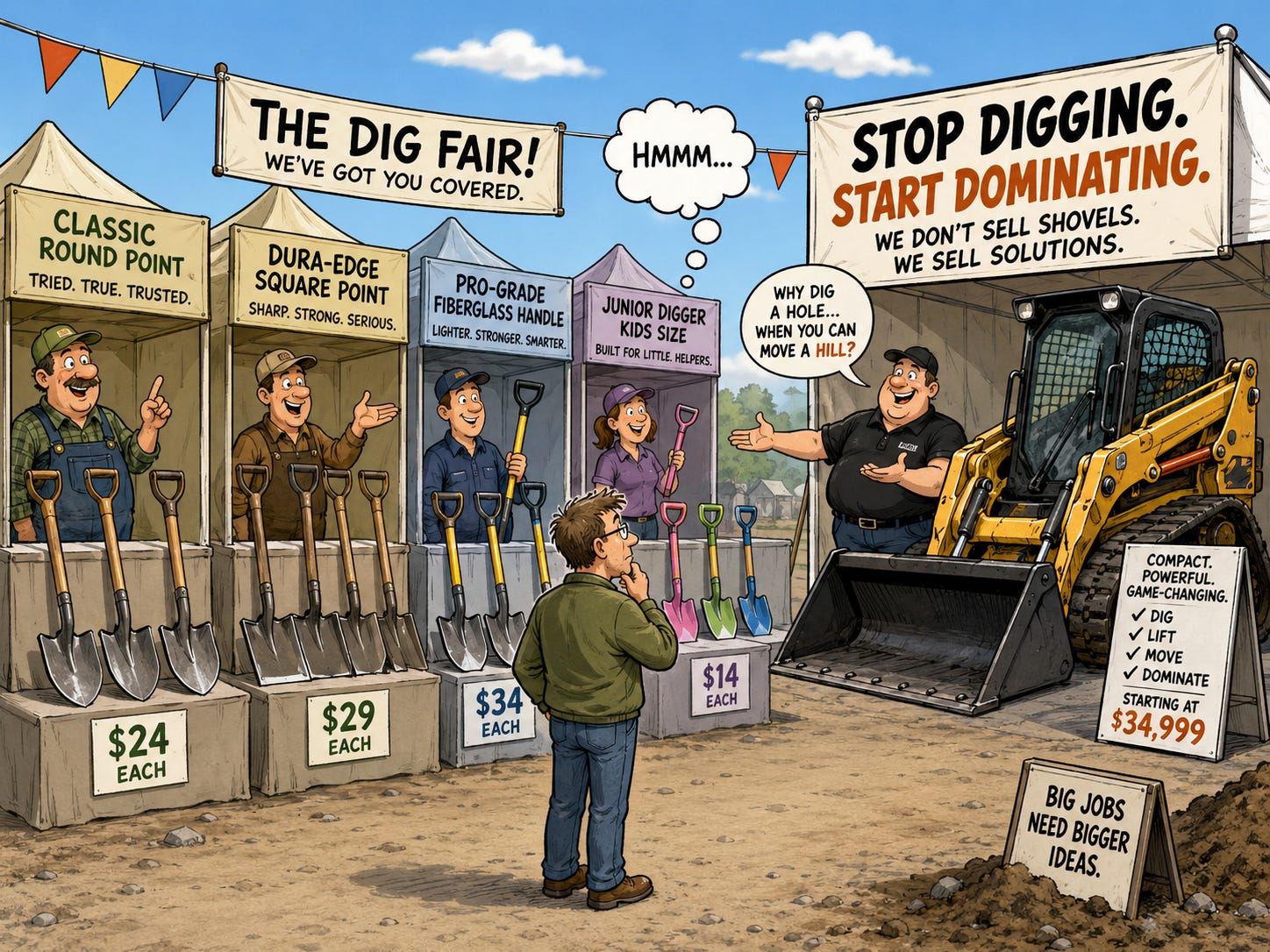
Yes, I am aware of the irony that I am using AI-generated images.
Which reminds me: why are people suddenly buying electrical contracting companies?
I am not a computer scientist, physicist, or mathematician, so for more specifics on those points a highly recommend reading the primers below where those aspects are explained. But long story short data is math. Software historically has consisted of a relatively fixed database and therefore a fixed set of calculations. But AI is more dynamic. The mathematical models it utilizes are much more advanced which takes more computing power in order to do the math and this scales somewhat exponentially. More users X More Prompts X the complexity of the questions X the quality of the models means the need for more computing power the more A.I. adoption there is.
Open AI today utilizes about 0.3GW and plans to build out 10GW of capacity. For context, in 2018 Amazon, Microsoft, Meta, and Google combined had about 4GW of capacity between them. In 2028 US total datacenter demand is projected at 74GW. For context, today the US as a nation produces somewhere between 480 and 485GW of power meaning we are projecting datacenters to consume over 15% of current US electrical production. Anyone hearing that has one of two reactions. “That’s ridiculous…” and “Thats Ridiculous!”
For the latter camp this buildout is a tremendous wave of opportunity. That means everything related to increasing power supply and the buildout of the datacenters is a direct play on artificial intelligence.
Power has meant modular generation in particular, fuel cells, generators, reactors, wind turbines, anything to get energy flowing. Grid equipment like transformers, switchgears, and any other components of electrical infrastructure. Cooling infrastructure is needed due to the immense heat created by GPUs, overclocking a system will lead to poor performance, so HVAC is having a great time. Obviously hardware such as GPUs, CPUs, servers, and now memory and storage are having their day. Memory for a long time was an oversupplied market. The innovation outpaced the demand and for a while memory had become so hated that capacity was beginning to shrink. Needless to say, not anymore. Networking infrastructure was historically even less loved; Ethernet cables, fiber-optics, and networking software have been revived. Additionally, water, which has been essential in the cooling process and in the manufacturing of the chips, has been an underrated bottleneck. Of course downstream the trades are in a revival because Wall Street realized that software engineers were not exactly going to be installing air-conditioners.

Citrini also has a series I highly recommend. Their timing has also been pretty good. I linked to their free research report below.

But in the wake of all this I believe we have made a classic capital cycle error. AI has big promises of efficiency that have not fully born themselves out yet. The biggest LLM companies like OpenAI and Anthropic are the most money-losing companies in history and it is not apparent how much pricing power these businesses truly have. Memory socks are having a revival of pricing power. But that will be mostly a lock-step game between Micron, Sandisk, and Samsung for the most part. Nvidia is far and away the leader in GPUs but with Alphabet, AMD, Amazon, Intel, and emerging startups challenging Nvidia’s reign we may approach a world of more competitive economics. Artificial intelligence threatens the world with a return to competitive economics. Where the incremental user does have cost but you still must invest in capital projects to produce enough to capture the customer. For more on this specifically, I highly recommend reading the most recent investor letter from Semper Augustus. CIO Chris Bloomstran breaks down how the new capital, combined with depreciation and the need for more incremental investment could dramatically change the returns one can expect from the largest tech companies.
https://static.fmgsuite.com/media/documents/35496d1f-21fa-496b-aa89-108c8a479d2a.pdf
But there has been the fear of disruption in software and the hope for great things in the power and data-center space. I find that is where most value investors make their money. We buy mispriced fear, and avoid mis-priced hope. I am not saying everything that has been beaten down will rebound, nor am I saying everything that has a large rise will come down. I am just being capital-cycle aware. The levers of shareholder return are in the growth, the margins and the multiple. And it looks to me like software has plenty of decent companies with depressed multiples with stable growth and stable margins while the AI buildout favorites have had tremendous growth, margin expansion, and multiple expansion. I can’t honestly believe that will continue but man does it feel bizarre to say that software will outperform the once-boring businesses.